Zach Boothgroverburger

相場の神様

Honma

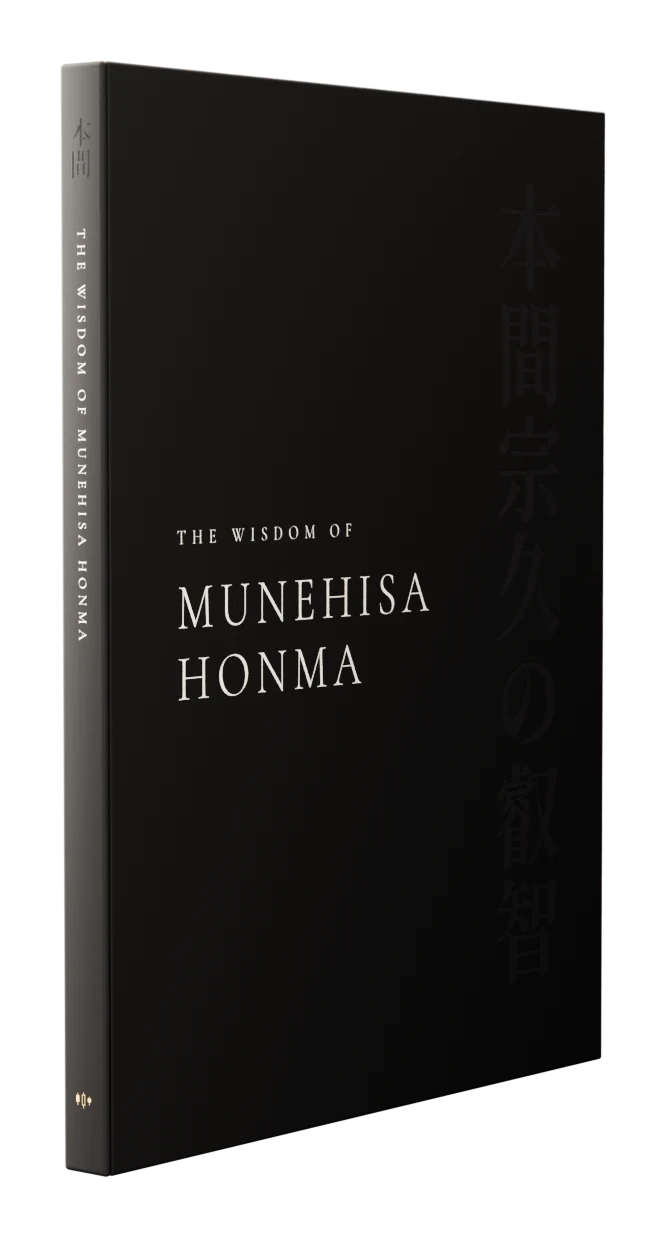
The Wisdom of Munehisa Honma brings the legendary Japanese rice trader's own teachings to English-speaking investors and traders for the first time.

A print edition is forthcoming on Amazon.

Front cover of The Wisdom of Munehisa Honma: English title over 本間宗久の叡智集 in vertical Japanese type on a warm paper ground
Preprint edition, 2026.

From the book

Honma writes about the hardest parts of trading: waiting, acting against the crowd, taking a profit, and knowing when to step away.

“When the impulse seizes you that today is the only chance, wait three days.”

Article 1 · The Initial Entry

“When the whole crowd is in an uproar, if everyone runs west and one faces east, one's fortune is certain.”

Article 3 · The Resolve to Leap into the Fire

“Flushed with victory, one whose profit is a hundred ryō begins to think of taking two hundred; the mind drifts to a thousand, then two thousand; lost in greed, one cannot bring oneself to cut and losses mount.”

Article 38 · Guidance for Times of Profitable Fortune

The trader

Munehisa Honma (本間宗久) was born in 1717 into a merchant family in Sakata, on Japan's northern coast. He traded rice at the Sakata and Osaka Dōjima exchanges with such success that later generations called him 相場の神様 — the God of the Markets.

His name is familiar in modern finance, but mostly through secondhand stories. His actual teachings—on market cycles, crowd psychology, risk, patience, and composure—have remained locked in older Japanese. This book makes them available to English readers for the first time.

The book

The Wisdom of Munehisa Honma: Market Aphorisms from the Legendary Rice Trader of Edo-Period Japan is a carefully produced collection of Honma's teachings, translated and edited by Zach Booth. The 6 × 9-inch edition pairs 139 short articles with their original Japanese headings, translator's notes, and an introduction to Honma and the Sakata rice market.

Some observations belong unmistakably to an eighteenth-century rice exchange. Others—fear at the bottom, euphoria at the top, the urge to chase, and the discipline to rest—feel as if they were written for markets today.

The source

The translation is drawn from Sōkyū-ō Sōba Zenshū (宗久翁相場全集), a 1910 collation of Honma's teachings preserved by the National Diet Library of Japan. No complete English translation of this material had previously been published.

The text was transcribed separately from the translation, difficult passages were reviewed by a professional Japanese-to-English translator, and every stage remains available in a public audit trail.

Two facing pages of the 1910 printed edition of Honma's collected teachings, set in dense vertical columns of classical Japanese type
Sōkyū-ō Sōba Zenshū (宗久翁相場全集), 1910 Shingidō edition. National Diet Library scan, public domain.

← Home